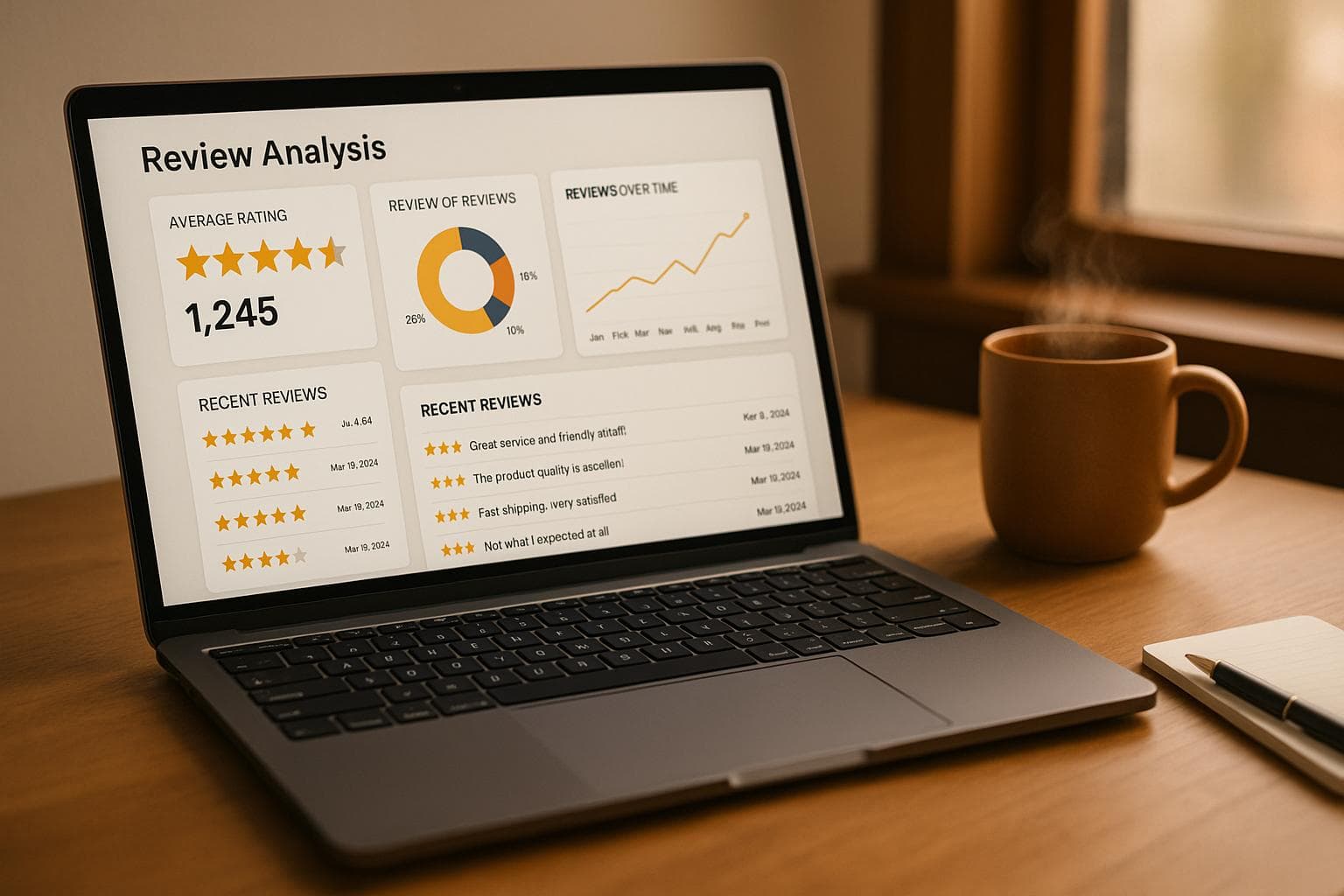
Competitor Review Analysis for Better Local SEO
Want better local SEO? Competitor review analysis is a powerful way to improve rankings and attract more customers. By studying competitor reviews, you can identify customer priorities, spot gaps in service, and refine your business strategy.
Here’s what you need to know:
- Customer reviews matter: 8 in 10 U.S. consumers search online for local businesses weekly, and reviews influence both search rankings and purchase decisions.
- Impact on SEO: Reviews account for about 9% of local ranking factors. Businesses with higher star ratings and active engagement perform better.
- Methods to analyze reviews: Use AI tools like CommentAssist for fast, automated insights, or go manual for deeper, hands-on analysis.
- AI vs. manual: AI saves time and scales easily, while manual analysis captures nuanced insights. Many businesses combine both for the best results.
Quick Comparison:
| Factor | CommentAssist | Manual Analysis |
|---|---|---|
| Time Investment | 15–30 minutes/week | 4–8 hours/week |
| Accuracy (Sentiment) | 75–85% | 90%+ |
| Scalability | Unlimited competitors | 2–3 competitors maximum |
| Cost (Annual) | $348–$2,388 | $3,900–$10,000+ |
| Real-time Monitoring | Yes | No |
| Contextual Insight | Limited | Excellent |
Key takeaway: If you want fast, scalable insights, AI tools like CommentAssist are ideal. For deeper, more contextual understanding, manual analysis is best. A hybrid approach often delivers the best balance of speed and insight.
How to Spy on Local SEO Competitors and Optimize GMB Categories in 2025
1. CommentAssist
CommentAssist takes the hassle out of managing competitor insights by automating data collection, response strategies, and analytics. It transforms this information into actionable steps to boost your local SEO, helping you stay competitive while saving time and effort.
Review Data Collection
CommentAssist goes beyond simply gathering reviews from platforms like Google, Yelp, and Facebook. It processes large volumes of data to uncover sentiment trends and flag shifts in the competitive landscape that might affect your local SEO. By categorizing reviews based on sentiment, topic, and frequency, it highlights patterns that reveal where competitors are excelling - or falling short. With all this data accessible from a single dashboard, there’s no need to manually visit multiple sites to monitor competitor performance.
These insights feed directly into strategies designed to enhance your local SEO.
Response Strategies
Powered by AI, CommentAssist crafts tailored response strategies based on competitor review trends. It analyzes how competitors handle customer feedback and helps you adopt similar techniques for your own review management. The platform automates responses to common themes while offering templates for more personalized interactions, improving your review scores and strengthening your local SEO.
What’s more, the AI adapts to your brand’s tone, ensuring all responses align with your unique voice. David Kim, CEO of Urban Style Boutique, shared his experience:
"The AI captures our brand voice perfectly - like having a dedicated social media manager at a fraction of the cost."
Maintaining this level of consistency is key to building a strong and professional online presence.
Analytics and Insights
CommentAssist delivers a wealth of analytics, including sentiment analysis, trends in review volume, keyword frequency, and competitor benchmarking. These tools allow you to measure your review performance against competitors, spot areas for improvement, and prioritize actions that can elevate your local SEO. Additionally, by identifying frequently mentioned keywords in competitor reviews, you can fine-tune your Google Business Profile and overall content strategy.
The platform also tracks response times, recurring complaint themes, and areas where competitors fall short, giving you the data you need to make smarter, more impactful decisions.
Scalability
Designed for businesses with multiple locations and high review volumes, CommentAssist centralizes review management, automates repetitive tasks, and delivers location-specific insights. This ensures consistent reputation management and improved local SEO across all branches, making it an ideal solution for franchises or businesses entering new markets.
As review volumes grow, the platform’s automation capabilities become even more valuable. Jennifer Adams, Principal at Adams Accounting, highlighted the benefits:
"We've seen a 40% increase in positive reviews since implementing CommentAssist. The AI responses are always professional and helpful."
For businesses handling hundreds - or even thousands - of reviews each month, CommentAssist’s unlimited review processing on higher-tier plans ensures that response quality and speed remain top-notch. This scalability allows for efficient, location-specific review management that directly supports your local SEO efforts.
2. Manual Competitor Review Analysis
Manual competitor review analysis offers a detailed, hands-on way to uncover insights, but it requires more time and effort compared to automated tools. Many businesses turn to this approach for a deeper understanding of local market dynamics. While labor-intensive, it can identify opportunities that automated systems might overlook.
Review Data Collection
Start by identifying local competitors using tools like Google's local pack and Maps. Once you've compiled a list of competitor business profiles, systematically gather data from multiple platforms.
Begin with Google Business Profile, as it directly influences local search rankings. Record key metrics like total review count, average star rating, and review frequency in a spreadsheet. Use U.S. formats for dates (MM/DD/YYYY) and numbers (comma-separated).
Next, expand to platforms like Yelp and Facebook, which are highly relevant for U.S. consumers. For industries like hospitality, include niche platforms such as TripAdvisor. Consistency is crucial - whether you collect data weekly or monthly, sticking to a schedule ensures you can track meaningful changes over time.
Here’s an example: A local HVAC company in Dallas manually tracked Google and Yelp reviews for their top three competitors. They discovered that slow response times were a common complaint among customers. Armed with this knowledge, they focused on improving their own response times, turning this insight into a competitive edge.
This structured data collection sets the stage for analyzing how competitors handle customer feedback.
Response Strategies
Analyzing competitor responses to reviews can reveal valuable patterns in customer service and common pain points. With 92% of consumers viewing business owner responses as part of good customer service, understanding these strategies is essential.
Pay attention to how quickly competitors respond and the tone they use. Some businesses reply to nearly every review with personalized messages, while others only address negative feedback. Note which approaches generate positive reactions or follow-up responses from customers. These details can help you refine your own response strategy to stand out in your market.
Analytics and Insights
Manual analysis goes beyond tracking numbers - it uncovers customer sentiment and recurring themes. While spreadsheets can help you monitor metrics like average ratings and review counts, reading individual reviews provides deeper insights into what customers value or dislike.
Look for patterns in both positive and negative feedback. For instance, if multiple customers praise a competitor’s transparent pricing, it might highlight an area where your business could improve. On the flip side, recurring complaints about a competitor’s scheduling process could be an opportunity to highlight your streamlined booking system.
Considering that 99% of consumers read reviews before making a local purchase decision, understanding what matters most to your target audience is crucial. Track frequently mentioned keywords in competitor reviews - these often reflect the priorities of local customers.
| Metric | Your Business | Competitor A | Competitor B |
|---|---|---|---|
| Average Star Rating | 4.2 | 4.6 | 3.9 |
| Total Review Count | 85 | 150 | 60 |
| Response Rate | 80% | 95% | 50% |
| Review Velocity | 2/month | 5/month | 1/month |
Scalability
While AI tools can handle large-scale data effortlessly, manual analysis becomes increasingly difficult as review volumes grow. Tracking multiple competitors across various platforms for expanding businesses or franchises can be time-consuming and prone to errors.
For single-location businesses with just a few competitors, manual analysis remains practical and budget-friendly. However, as businesses expand into new markets or add locations, keeping up with detailed manual analysis can strain resources.
Take the Dallas HVAC company as an example: within three months of applying insights from their manual competitor review analysis, they improved their average rating and secured a spot in the local pack for key search terms. But as they grew to serve additional Texas markets, maintaining the same level of detail in their manual analysis became much harder.
With 8 in 10 U.S. consumers searching for local businesses online weekly and 32% doing so daily, review landscapes change rapidly. This constant activity makes it challenging for manual processes to keep pace with real-time developments, especially for businesses operating in multiple locations or industries.
sbb-itb-5375359
Advantages and Disadvantages
When deciding between CommentAssist and manual competitor review analysis, it's essential to weigh the trade-offs between efficiency and depth, cost and customization, as well as speed and strategic insight. Both approaches have their strengths, and the right choice depends on your local SEO goals and resources.
CommentAssist can process thousands of competitor reviews in just minutes, offering real-time sentiment analysis to highlight rating trends or emerging issues. This eliminates the 4–8 hours of weekly effort typically required for manual analysis. However, manual analysis brings a level of depth and contextual understanding that automation often misses.
That said, automated tools like CommentAssist have their limitations. With an accuracy rate of 75% to 85%, some reviews may be misclassified due to challenges like sarcasm, complex phrasing, or industry-specific jargon. These nuances can occasionally trip up the AI, leading to potential misinterpretations.
Manual analysis excels in capturing context. Skilled professionals can identify subtle sentiments with over 90% accuracy, uncovering not just customer opinions but also the underlying reasons behind them. For instance, a manual review might reveal that customers frequently complain about a competitor's "rushed service" during peak hours - an insight that goes far beyond a simple negative sentiment score.
Additionally, manual analysis allows for deeper strategic connections. Experts can link review insights to broader local SEO opportunities, such as optimizing your Google Business Profile, refining keyword strategies, or tailoring content plans. These are areas where automated tools often fall short.
Cost is another critical factor. CommentAssist pricing starts at $29 per month for basic features and scales up to $199 per month for enterprise-level access. On the other hand, manual analysis costs vary widely. If you use internal staff, the cost might range from $15 to $50 per hour, while hiring external consultants could set you back $1,500 to $5,000 per month. For example, a small business dedicating 3 hours per week to manual analysis at $25 per hour would spend about $3,900 annually. In contrast, automated tools become more economical when manual analysis exceeds 10–15 hours per week.
| Factor | CommentAssist | Manual Analysis |
|---|---|---|
| Time Investment | 15–30 minutes/week | 4–8 hours/week |
| Accuracy (Sentiment) | 75–85% | 90%+ |
| Scalability | Unlimited competitors | 2–3 competitors maximum |
| Cost (Annual) | $348–$2,388 | $3,900–$10,000+ |
| Real-time Monitoring | Yes | No |
| Contextual Insight | Limited | Excellent |
| Customization | Basic | Highly customizable |
Reliability also varies. CommentAssist provides consistent, repeatable results - running the same analysis twice will yield identical findings. Manual analysis, however, is subject to human bias and inconsistency, particularly during lengthy review sessions when fatigue can play a role.
Given these differences, many businesses are opting for a hybrid approach. This strategy combines the strengths of both methods: using CommentAssist for real-time monitoring and baseline data collection, while conducting monthly manual deep dives into the insights flagged by automation. A hybrid model typically costs between $1,500 and $2,500 per month and delivers a more well-rounded set of actionable insights.
Ultimately, your decision will depend on your specific needs, resources, and competitive environment. For businesses needing fast, scalable monitoring across multiple competitors, CommentAssist offers a clear advantage. Meanwhile, those seeking detailed, context-rich insights may find manual analysis indispensable for driving meaningful improvements in their local SEO efforts.
Conclusion
The best approach for managing reviews depends on your business size, the number of reviews you receive, and the resources you have available. Different strategies suit different situations.
For smaller businesses with fewer reviews, manual analysis often works well. Take, for example, a single-location boutique that focused on crafting personalized responses. This approach helped them build strong customer loyalty and generate valuable word-of-mouth referrals. When review volumes are manageable, adding that personal touch can create meaningful customer connections, which can be a key differentiator.
On the other hand, businesses with multiple locations or those handling a large volume of reviews often benefit from AI tools. One restaurant chain with locations nationwide used CommentAssist to process thousands of reviews each month. This not only led to a 20% boost in positive review volume but also improved their local search rankings. Automation helped them streamline their review management while maintaining consistent messaging across all their locations.
A hybrid approach is another option, blending the strengths of both methods. For instance, you can use CommentAssist for real-time review monitoring and initial data analysis while conducting occasional manual deep dives into flagged insights. This way, you balance efficiency with thoughtful, strategic engagement.
Ultimately, your choice should align with your team’s capabilities and your broader local SEO goals. Even small businesses without dedicated SEO teams can use tools like CommentAssist to implement effective local SEO strategies - especially considering that 58% of customers are open to AI-written review responses.
Whether you go with AI automation, manual analysis, or a mix of both, selecting the right system tailored to your business needs and resources will help improve your local SEO performance.
FAQs
How does analyzing competitor reviews improve my local SEO strategy?
Analyzing competitor feedback gives you a window into what customers in your industry value most, what frustrates them, and where services might fall short. By tackling these issues within your own business, you can elevate customer satisfaction and encourage a steady flow of positive reviews.
On top of that, paying attention to the keywords and phrases that pop up repeatedly in competitor reviews can sharpen your local SEO strategy. Weaving these terms into your content can boost your visibility in local search results, helping you connect with more potential customers.
What are the benefits of combining AI tools with manual analysis when evaluating competitor reviews?
Combining AI tools with manual analysis creates a powerful method for examining competitor reviews. AI tools excel at processing vast amounts of data quickly, spotting patterns, and delivering insights that save both time and effort. On the other hand, manual analysis brings a human touch, capturing context, tone, and subtle nuances that automated systems might overlook.
This balanced approach helps businesses identify overlooked opportunities, address weaknesses in their strategies, and fine-tune their local SEO efforts. By blending the speed and precision of AI with the depth of human understanding, companies can make sharper, well-rounded decisions to boost their online visibility and improve customer satisfaction.
How does CommentAssist ensure automated responses reflect my brand's voice and customer engagement goals?
CommentAssist fine-tunes its automated replies to reflect your brand's specific voice and messaging. By adjusting the settings, you can ensure that every interaction stays aligned with your preferred style, maintaining a consistent tone across all communications.
Need more control? You have the option to let the tool handle responses automatically or review them before they go live. This way, you decide how your business engages with customers.